
Mrs. Gayle T. Salalima Abadina’s profile reflects something more structurally significant?an operational leader who understands how scholarly ecosystems actually function, not just how they appear.
As Executive Director of the International Association of Scholarly Publishers, Editors, and Reviewers (IASPER), her role is not ceremonial. It is managerial, strategic, and deeply relational. Many individuals in similar positions struggle with execution despite impressive titles. That does not seem to be the case here. Her effectiveness lies in her ability to bridge administrative rigor with interpersonal fluency?two competencies that rarely coexist at a high level.
From an intelligence standpoint, what stands out is not abstract brilliance but applied cognition. Coordinating international conferences and workshops across Asia and ASEAN requires more than academic knowledge. It demands logistical foresight, cultural sensitivity, and rapid decision-making under constraints. These are indicators of practical intelligence?often undervalued, yet critical in global scholarly operations.
Her skillfulness becomes more evident when examining IASPER?s activities. International academic events are inherently complex systems: multiple stakeholders, tight timelines, varying academic standards, and cross-border coordination. Many organizations fail at scaling such operations without compromising quality. The consistency of IASPER?s conferences suggests disciplined planning and process control?areas typically overseen or directly influenced by executive leadership. This implies that Mrs. Abadinas is not only involved but also competent in systems-level management.
Interpersonal communication is another domain where her profile is notably strong. In academic environments, communication failures are common?misaligned expectations, unclear guidelines, or ineffective coordination between scholars. Her ability to maintain engagement with global researchers, editors, and reviewers indicates a high level of communicative precision. This is not about being personable in a superficial sense; it is about transmitting clarity, building trust, and sustaining collaboration across diverse academic cultures.
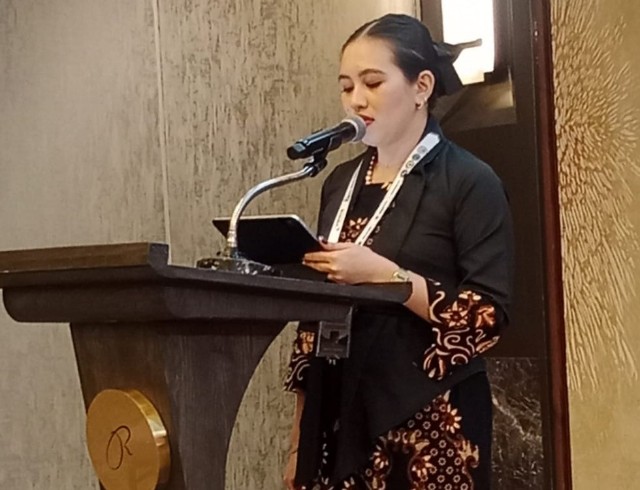
The photograph reinforces this interpretation. Her posture at the podium is controlled and deliberate. She is reading, not improvising, which suggests preparation and respect for content accuracy?an important trait in scholarly settings. Her attire, combining formal structure with traditional batik elements, signals a calculated professional identity: globally competent yet culturally grounded. This is not incidental. In international conferences, visual presentation contributes to perceived authority and credibility.
However, it would be incomplete to idealize her profile without scrutiny. The challenge for leaders in organizations like IASPER is sustainability. Managing frequent international engagements can lead to operational fatigue, quality dilution, or over-centralization of decision-making. The real test of her leadership is whether she is building systems that function independently of her constant oversight. Strong managers eventually need to become system designers, not just system operators.
In sum, Mrs. Gayle T. Salalima Abadinas represents a model of executive leadership grounded in execution rather than rhetoric. Her intelligence is functional, her skills are operational, and her communication is strategically effective. The image from the Rembrandt Hotel in Bangkok does not merely show a speaker?it captures a professional who understands that global scholarly engagement is less about visibility and more about sustained, disciplined coordination. (Bas/Dj)